Why Curiate's Focus Time may be a tonic in the age of distraction
Refocusing app incentives toward sustained attention
Curiate is an ad-free content discovery app for iOS and the web. Premium is $2/month with a 7-day free trial.
The attention economy and the endless scroll
Modern apps pull us in and reward our impulse to keep scrolling and chase the next thing. The exchange feels hollow and one-way: we feed these apps our attention and maybe get a chuckle or the sense of being more informed. Going deep on anything starts to feel pointless. Why spend an hour on a topic when AI can summarize it instantly, and a 30-second clip from an engaging face on TikTok can make you feel like an expert on something you never really learned?
In the 22 years since Facebook launched, the attention economy has reshaped daily life. You can see it everywhere, from silent bus rides with dozens of eyes glued to glowing screens to a polarized political climate fueled by a cacophony of short, outraged posts.
The data backs up what many of us feel. Psychologist Gloria Mark has found that the average time people stay focused on a single screen before switching fell from about 2.5 minutes in 2004 to roughly 47 seconds in recent years (APA). Reading skills are slipping too: in 2024, 32% of U.S. 12th graders scored below the basic level in reading, up from 20% in 1992 (NAEP, 2024).
I built Curiate as a response to this trend. Its newest feature, Focus Time, is an experiment: can we use some of the same tricks that popular apps used to shrink our attention spans to help rebuild them?
What is Focus Time?
Focus Time is a Curiate Premium feature that rewards you for sustained attention rather than for scrolling. Pick an article, video or book from Curiate and give it your full attention; for example, go read for 30 minutes. When you come back to the app, Curiate logs that session as Focus Time.
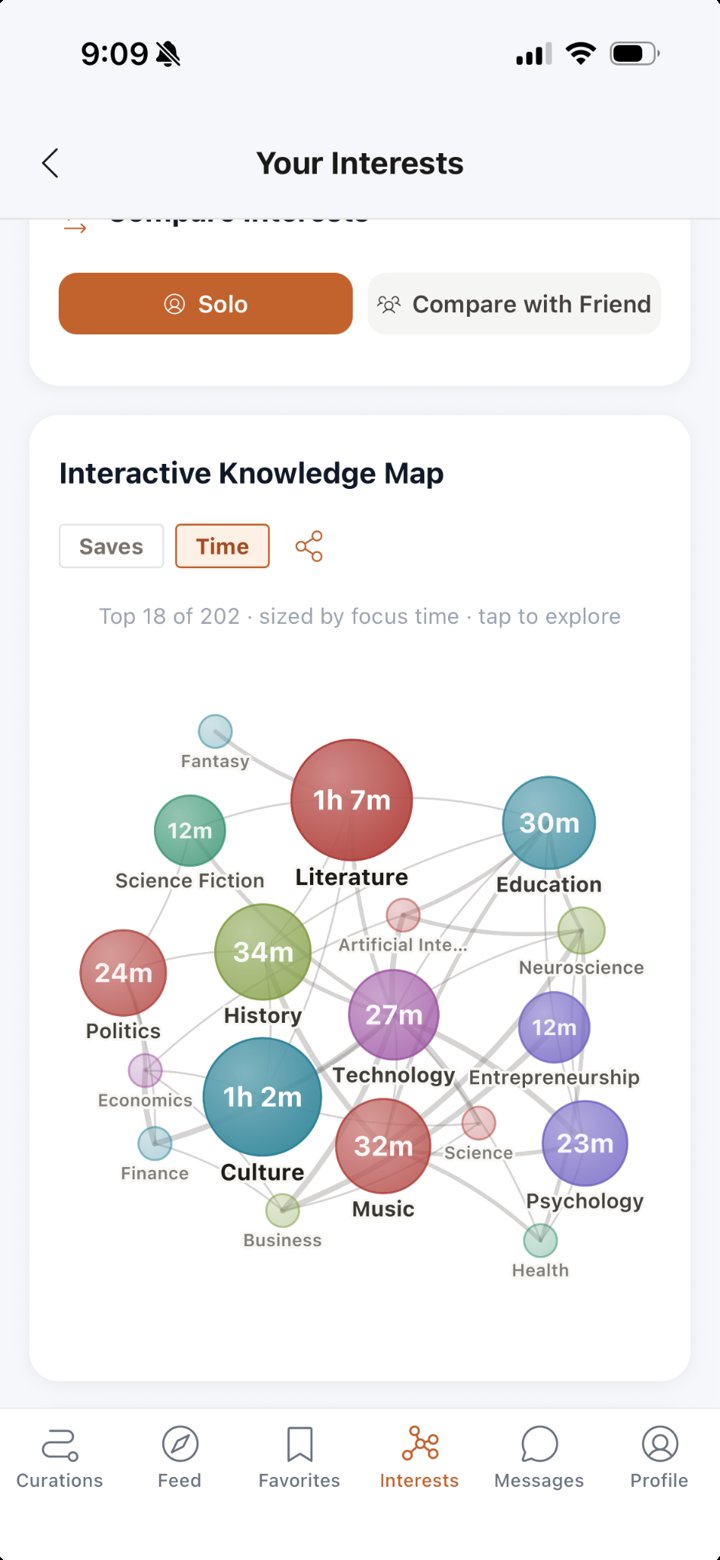
Everything you read or watch through Curiate is categorized by topic, so your Focus Time also grows your personal knowledge map, a visual record of what you have explored and how those topics connect. Premium also adds a daily goal and streak to help you build a consistent habit, and curations built from your own saves. Curiate's library itself stays free.
In the rest of this essay I cover the evidence on how short-form media and engagement-optimized algorithms affect our attention, why sustained attention is worth protecting, and how Curiate is designed differently from mainstream apps.
How short-form media is changing our attention
How worried should we be about our collective phone habits? Phones have been aptly described as adult pacifiers, and many of us struggle to set them down and engage with the world. Across the apps we depend on, content keeps getting shorter, and most of us now take in information in quick bursts. That format is popular and hard to put down, largely by design.
Writing in The British Journal of Psychiatry, David Rhys Alchin calls this kind of content "ultra-processed information," a nod to ultra-processed food: fragmented, optimized for engagement, and built to compete endlessly for our attention. He points to a more than five-fold rise in the number of Australians taking psychostimulant (ADHD) medication, from about 107,000 in 2012 to over 590,000 in 2023–24, with growth concentrated among adults. He argues that some of this may reflect "environmentally mediated attentional dysregulation": attention problems driven by our information environment that, at the level of symptoms, look almost identical to ADHD (Alchin, 2026).
The growth of short-form video makes this especially relevant. YouTube Shorts viewership has nearly tripled in the past two years, and the average TikTok user spends over 95 minutes a day on the platform (Kapwing, 2026). You may feel like you are learning from these feeds, but you are probably retaining less than you think. In a 2026 study in Communications Psychology, people shown the same information as a series of short clips recalled significantly less than those who watched one continuous video, and the gap widened by the next day (PsyPost summary).
A 2025 meta-analysis in Psychological Bulletin covering 71 studies and roughly 98,000 participants found that heavier short-form video use was associated with poorer cognition, most consistently with weaker attention and impulse control (Nguyen et al., 2025). These are correlations, not proof of cause, but they line up with the "brain rot" headlines you have probably seen.
Reading is taking a hit as well. In her August 2026 cover story for The Atlantic, "The End of Reading Is Here," Rose Horowitch argues that we are entering a "post-literate" age (The Atlantic). Teachers see it firsthand in students who struggle to finish books or dig for deeper meaning. Some have scaled back: the average number of books assigned per year in U.S. high school English classes has reportedly dropped from about 4 in 2008–09 to 2.8 in 2024–25 (The Conversation). Among adults, the share who read at least one book in the past year fell from 54.6% in 2012 to 48.5% in 2022 (National Endowment for the Arts).
Why reading and sustained attention matter
Maryanne Wolf, a UCLA scholar who studies how reading shapes the brain, argues that deep reading builds empathy by immersing us in other perspectives, and that it is essential for learning to reason and discern truth. She worries that young people face a double squeeze: fewer are reading deeply, while tools like ChatGPT make it easy to outsource their thinking. The result is a generation with less practice forming and articulating complex thoughts (UCLA).
Beyond making us more discerning, reading strengthens mental stamina and focus, supports productivity, reduces stress and may even lower the risk of cognitive decline. The benefits compound with practice: people who read more show greater brain volume in regions tied to learning, emotional regulation and cognition (Smithsonian).
Reading is a great way to train focus, and focus unlocks a lot else. Children's attention spans are closely linked to their reading and math scores (PMC), and some researchers argue that attention predicts workplace productivity better than IQ or memory (Institute of Organisational Mindfulness). Cal Newport's Deep Work makes the case that the ability to focus without distraction is a modern superpower (Cal Newport). From relationships to school to work, the ability to stay focused pays off.
How Focus Time realigns app incentives with sustained attention
The good news is that focus can be rebuilt with practice. Rose Horowitch puts it well:
"The more you read, the easier it is to read, and the more you're rewarded with new understanding. Eventually the process is more pleasurable than it is challenging. But as with physical exercise, the converse is true as well: The less you read, the more difficult it is to read, and the rockier the path to acquiring knowledge."
— Rose Horowitch, The Atlantic
Curiate is meant to be a place to practice exactly that: being intentional, focused and engaged with long-form content. Most apps measure success by how long they can keep you scrolling. Focus Time measures something else: how long you stayed with one thing.
For me, Focus Time was like flipping on a light switch. Before it existed, I caught myself scrolling through Curiate's own recommendations without ever committing to an article or a video. As soon as I knew I was getting credit for my time, that changed, and I read entire articles start to finish for the first time in years.
I want Curiate to be an app you actually want to open. As a small independent developer, I can build the alternative I want to see without answering to corporate pressure for growth at the cost of our well-being. Here are the key design decisions that set Curiate apart from apps like TikTok and Instagram:
| Curiate | Instagram / TikTok | |
|---|---|---|
| What gets rewarded | Focus Time and achievements reward sustained attention on one piece of content. | Engagement metrics reward more swipes, taps and time in the feed. |
| Feed | A focused, finite set of results you refresh on purpose. | An infinite scroll with no natural stopping point. |
| Recommendations | Fully user-controlled: based only on what you have saved, with toggles to change them. | Opaque algorithms tuned to maximize time on app; little user control. |
| Content | Articles, videos and books from long-form, quality sources, plus curated learning paths. | Short-form, "ultra-processed information." |
| Ads | None. | Everywhere. |
To be clear, Focus Time is an experiment, not a clinical treatment. But if apps can be designed to erode our attention, it seems worth testing whether one can be designed to help rebuild it.
Try Focus Time free for 7 days
You can try Curiate Premium free for 7 days and see the difference for yourself. At $2/month, it is less a purchase than a statement to yourself: you would rather spend your time rebuilding your focus than feeding the mindless scroll. Join Curiate and be part of this experiment to see if we can bring back our focus in a highly distracting digital world.
Sources
- Mark, G. "Why our attention spans are shrinking." Speaking of Psychology, American Psychological Association. apa.org
- National Assessment of Educational Progress. "2024 Reading, Grade 12: National Trends." nationsreportcard.gov
- Alchin, D. R. "Cognitive overload in the attention economy." The British Journal of Psychiatry, 2026. cambridge.org
- Kapwing. "Short-form video statistics: TikTok, Reels and Shorts by the numbers in 2026." kapwing.com
- Wei, M., & Dong, G.-H. Short vs. continuous video learning study, Communications Psychology, 2026. Summary: psypost.org
- Nguyen, L., et al. "Feeds, feelings, and focus: A systematic review and meta-analysis examining the cognitive and mental health correlates of short-form video use." Psychological Bulletin, 2025. psycnet.apa.org
- Horowitch, R. "The End of Reading Is Here." The Atlantic, August 2026. theatlantic.com
- "College professors face an emerging challenge: We know students are no longer reading entire books." The Conversation. theconversation.com
- National Endowment for the Arts. "The men-women split in reading is real, and persists amid historical rate declines." 2025. arts.gov
- UCLA School of Education & Information Studies. "Maryanne Wolf: Deep reading, a tool for attaining empathy, critical thinking skills." seis.ucla.edu
- Smithsonian Magazine. "From boosting mental health to reducing dementia risk, here's why reading is extremely good for you." smithsonianmag.com
- Attention and academic achievement in children. PMC. ncbi.nlm.nih.gov
- Institute of Organisational Mindfulness. "Attention is today's productivity gap." iomindfulness.org
- Newport, C. Deep Work: Rules for Focused Success in a Distracted World. calnewport.com