Curiate Blog
How to get back into reading: a realistic two-week restart
Make room for books and saved articles without creating another obligation

Your saved articles describe a person with a wonderfully varied intellectual life. Your actual Tuesday leaves little time to be that person.
Returning to reading can begin with a piece you want to read today, rather than an annual challenge.
To get back into reading, pick something you genuinely want to read, attach a small session to a dependable moment in your day, and leave yourself an easy next step. Try the arrangement for two weeks, then adjust it around what happened.
Two weeks is a workable window for trying a routine and seeing what happens. It is not a promise that reading will become automatic in fourteen days.
Reconnect with the kind of story that once absorbed you
What was the last book you could barely put down? Do you remember reading Harry Potter late into the night as a child, promising yourself one more chapter? Think about what held you there: the friendships, the mystery, the magical school or the feeling of discovering another world.
If it was fantasy, try another series that offers the same kind of pleasure. You might want the scale of The Way of Kings, the storytelling of The Name of the Wind, or a shorter adventure. Our guide to engrossing fantasy series suggests seven starting points. Rereading an old favorite is a good option too.
The same question works beyond fantasy. If you loved detective stories, biographies or popular science, start there. Choose a book that makes you want to know what happens—or what the answer is—rather than something you feel obliged to finish.
Articles count as reading. If your goal is to return to books, keep a book in the plan too.
Clear a small space in your reading queue
An archive and a next-up list serve different purposes. An archive preserves possibilities. A next-up list makes the next session easy to begin.
For this experiment, choose just three possibilities:
- One easy start: an inviting article, short story or familiar chapter.
- One main read: the book or longer piece you want to continue.
- One curiosity detour: something outside your usual subjects.
Keep other saves in the archive and remove pieces you no longer want to read. Adjust the queue size if necessary.
If you need sources, our article-discovery app guide compares ways to find them. Choose the next piece before opening another discovery feed.
Give the session a dependable cue
“Read more” leaves the moment of action undecided. “After I brush my teeth tonight, I will read for fifteen minutes” gives you a recognizable opportunity and a specific first step.
Psychologist Peter Gollwitzer describes this kind of if–then planning as an implementation intention: connecting an anticipated situation to an intended action. Research across goal-pursuit settings supports this approach. Read Gollwitzer's research overview.
Choose a reliable cue—breakfast, a train journey or finishing an evening task—when you have enough energy and time to read.
Then prepare the first step: put the book where you sit, download the article, or leave a bookmark at the next section. Make the reading available before the window opens.
Try reading as your bedtime wind-down
Bedtime offers a recurring place for reading, even when the rest of the day gets crowded. Leave a book beside your usual evening chair or bed and give it fifteen quiet minutes before lights-out.
This can fit a sleep-friendly routine. The National Heart, Lung, and Blood Institute recommends quiet time before bed, avoiding bright artificial light. In a seven-night randomized reading trial, more participants assigned to read for 15–30 minutes before sleep reported improved sleep than those assigned not to read. The results relied on self-report, and more participants dropped out of the reading group (about 26%) than the control group (about 18%).
Try a paper book or a dimmed e-reader and put notifications aside; the trial tested reading a book, not a particular format. Keep a stopping time so an engrossing story does not push bedtime later. If evenings leave you too tired, use a different dependable cue.
Your two-week reading restart
Use this suggested schedule to find a workable arrangement; move the days around as needed.
| Days | Your task | What to notice |
|---|---|---|
| 1–2 | Pick your three-item queue and try one short session | Did you want to continue? Was starting straightforward? |
| 3–4 | Use the same cue and return to your main read | Was the cue available? What interrupted it? |
| 5–6 | Change one obstacle: timing, device setup or reading choice | Did that change make beginning easier? |
| 7 | Review the first week without catching up | Which conditions worked? What can you remove? |
| 8–10 | Repeat the workable arrangement | Can you begin without choosing everything again? |
| 11–13 | Continue the main read; extend a session if you want to | Is the material rewarding enough to return to? |
| 14 | Choose a sustainable version for the next week | What is your next cue, piece and starting point? |
Begin with a small appointment, perhaps ten minutes. You can finish a short piece or read part of a chapter.
For pleasure reading, simply enjoy the session. For an article you want to use later, save its link and one idea or question.
At the end, leave a visible next action: “Continue at the heading about the evidence,” or a bookmark in the novel. Tomorrow's session should not require rebuilding today's plan.
A missed day does not require a recovery marathon
In a real-world habit study, health psychologist Phillippa Lally and colleagues followed volunteers repeating an eating, drinking or activity behavior in a consistent context. The modeled time to approach automaticity varied substantially, from 18 to 254 days (the upper figure was extrapolated beyond the 12-week study). Missing one opportunity did not materially derail the modeled process. These were health-related behaviors, not reading; the estimates are not reading-habit deadlines. Read the study abstract.
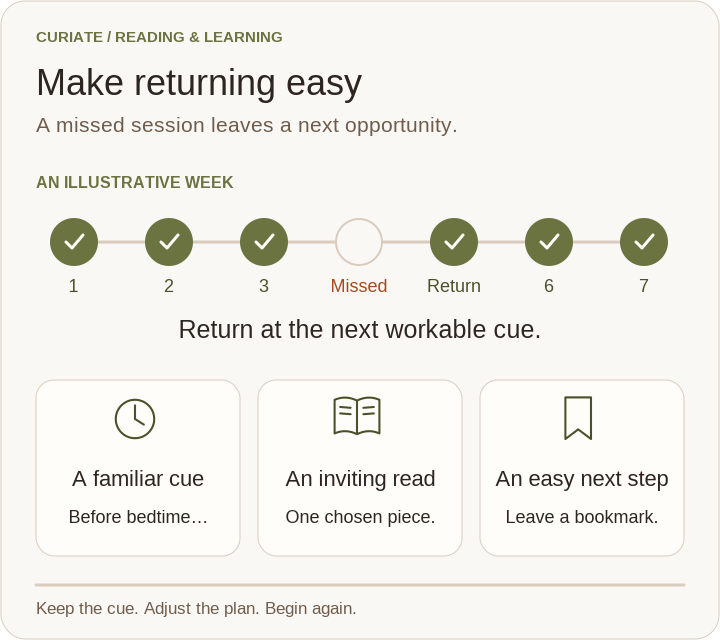
For this reading experiment, respond to a missed session by returning at the next workable cue. Do not double the target as punishment.
If you miss several sessions, inspect the cue, the material and the size of the commitment. Change the obstacle you can identify.
Track what helps you return
A calendar tick is enough if all you want is to notice the days you read. You could also record the piece, approximate time and one thing you enjoyed or understood. Keep tracking lighter than the activity.
Curiate publishes this guide. Our free library brings together microlessons and original articles, videos and books. A finite feed helps you choose a starting point without an endless scroll; saving gives you a way to keep a short next-up list.
Premium's Focus Time rewards going beyond the microlesson into the source. It counts eligible article-reading and video-viewing sessions by topic, with a daily goal and streak. For an external article, open the source from Curiate and return after reading; on the web credit uses the time away and return, while the iOS reader counts active reading and pauses after a minute without scrolling or touching. Sessions under a minute are excluded. That measures a session, not comprehension. Books marked as read have a separate tally.
After two weeks, keep the cue and material that made returning easiest. A bookmark and calendar can track the routine too.
Frequently asked questions
How do I get back into reading after years away?
Begin with material you want to read now, even if it is shorter or easier than what you used to choose. Put it at a dependable point in your day and leave an obvious next step. Adjust the routine based on your first few sessions rather than comparing yourself with an old reading pace.
What should I do with hundreds of unread saved articles?
Keep the archive separate from a small next-up list. Choose a few pieces for the coming week and remove items that no longer interest you. You do not need to clear the entire backlog before enjoying something new.