Curiate Blog
How to remember what you read: a practical active-recall method
Keep the ideas that matter without turning every article into homework

You recognize the headline. You remember thinking the article was excellent. Asked what it actually argued, you can produce something like: “It was about how habits work.”
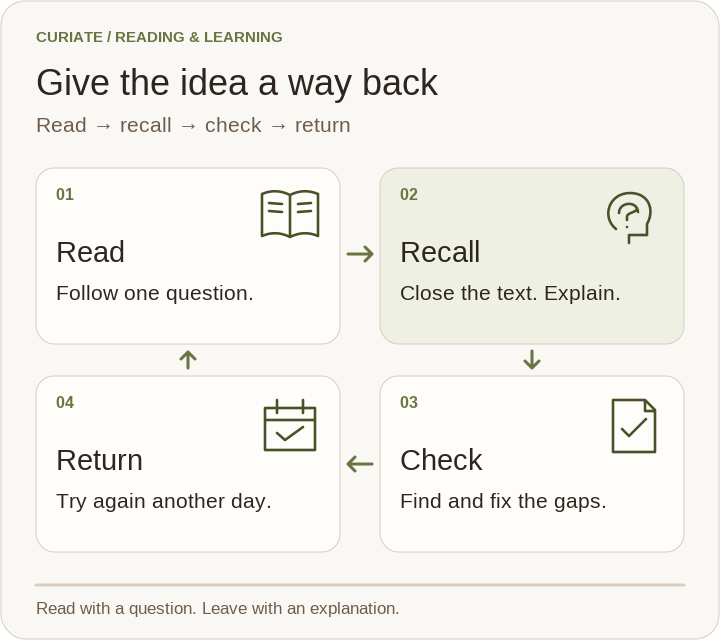
To remember what you read, choose a question, read a manageable section, close the text and explain its answer from memory. Reopen it to correct yourself, then return to the question on another day. That combines active recall with review spread over time.
Why rereading can feel more successful than it is
Looking at a familiar passage gives you its wording, structure and prompts. Explaining it with the page closed asks a different question: can you bring the idea back when those prompts are absent?
Psychologists Henry Roediger and Jeffrey Karpicke tested this distinction using prose passages. Repeated study helped on an immediate test, while retrieval practice produced better retention on delayed tests. Confidence pointed the wrong way: students felt surer of what they had reread, yet recalled less after a delay. The students were undergraduates reading short science passages, not adults reading articles. Read the original study.
The evidence extends beyond that experiment. A review by learning researchers Pooja Agarwal, Ludmila Nunes and Janell Blunt examined 50 classroom experiments involving 5,374 students and found benefits across varied educational settings. Most experiments came from a limited range of countries; the findings support classroom recall practice, rather than proving a benefit for every reading context. Read the systematic review.
A reading routine you can use today
Here is a practical way to apply those findings. The routine itself is our adaptation: the studies tested students, and no study has tested these steps as a package.
1. Pick the question you want the piece to answer
Turn the title or your curiosity into a question. “What does this author think causes the problem?” is more useful than “Learn about productivity.”
For a research report, try: “What did the researchers change, what did they measure, and what did they find?” For an opinion piece: “What is the argument, and which evidence does it depend on?”
2. Read one meaningful section
Use a heading, a complete explanation or a short article as the stopping point. Stopping every sentence makes it difficult to follow an argument. Waiting until the end of a dense book makes the recall task unnecessarily large.
Highlight sparingly if it helps you return to a passage. After highlighting, you still need to decide what the passage means and whether it supports the author's conclusion.
3. Close the text and reconstruct the answer
Write or say three things:
- The main answer in your own words.
- One piece of evidence or a concrete example.
- One qualification, unanswered question or boundary.
You do not need polished prose. “I remember the recommendation but cannot remember the evidence” is a useful result. It tells you where to look next.
Give yourself an honest attempt before reopening the source.
4. Check the source and repair the note
Look for missing conditions and exaggerated conclusions. Did “associated with” become “causes”? Did an experiment involving students turn into a statement about everyone? Did the author offer an illustration that you remembered as a finding?
Keep the correction visible. You might write: “Correction: the experiment tested memory after a week; it did not measure permanent learning.” Save the source link beside the note so you can check it again.
5. Return to the question later
Try answering again tomorrow, then later in the week if the idea still matters. Check afterward. Adjust the intervals to what you need to retain.
Researcher John Dunlosky's overview of effective study techniques rated both practice testing and distributed practice among the most effective of the ten study techniques it reviewed. The relevant comparison is revisiting material across sessions versus concentrating all practice together. Read his explanation of the research.
If you cannot answer, shorten the question or revisit the explanation. If you can answer readily and no longer need the detail, stop reviewing it. Your reading system should not create an unlimited maintenance job.
A worked example: remembering a science article
Suppose you read NASA's explanation of what spectroscopy reveals beyond temperature and composition. One section explains how astronomers use shifts in spectral lines to study motion.
A vague note would be: “Light tells us how stars move.” It sounds reasonable but gives you little to work with later.
Here is a more useful reading note, written for the section about motion toward or away from us:
Question: How can a star's spectrum reveal motion along our line of sight?
Answer: Compare recognizable spectral lines with their laboratory wavelengths. Motion away shifts them toward longer wavelengths; motion toward us shifts them toward shorter wavelengths.
Boundary: This section explains Doppler shifts. I should not use that explanation as the complete account of every astronomical redshift.
Follow-up: Why are identifiable lines more useful than simply judging a star's apparent color?
Close the article before attempting your version. Then check NASA's explanation and diagram. Tomorrow, answer the question again without reopening the page first.
How much should you write down?
Enough to recover the idea and find its source. For a short article, a question and three rough sentences may be plenty. For a complicated argument, you may need a diagram, several questions or separate notes for competing explanations.
If you enjoy maps, draw one from memory before checking it. If notes take longer than the reading and you never return to them, reduce the format.
Where Curiate fits
Curiate publishes this guide and builds the app described here. Its microlessons introduce ideas from articles, videos and books, with links to the original sources. You can use the lesson to get oriented, then read the full piece and make your own recall note.
Quick Checks cover the in-app microlessons; Focus Quizzes draw on the original sources. Free readers get one Quick Check a day and their first Focus Quiz free; Premium makes both unlimited. Our microlearning app comparison explains the options.
Frequently asked questions
Is highlighting enough to remember an article?
Highlighting can mark passages worth returning to, but a highlighted page does not show that you can explain its ideas. Add a brief recall attempt and check your answer against the source. Keep useful quotations clearly separate from your own interpretation.
Should I use active recall for every book?
No. Choose it when you want to retain or apply particular ideas. You can read fiction, essays or poetry for the experience without making notes or quizzes. For nonfiction, begin with one question that matters to you rather than trying to memorize every detail.
How can I remember what I read without taking lots of notes?
Say your explanation aloud, then check it. Keep the source link and one question to revisit; an extensive notebook is optional.