Curiate Blog
Reading vs watching videos: which is better for learning?
Choose the format for the question, then check what you can explain
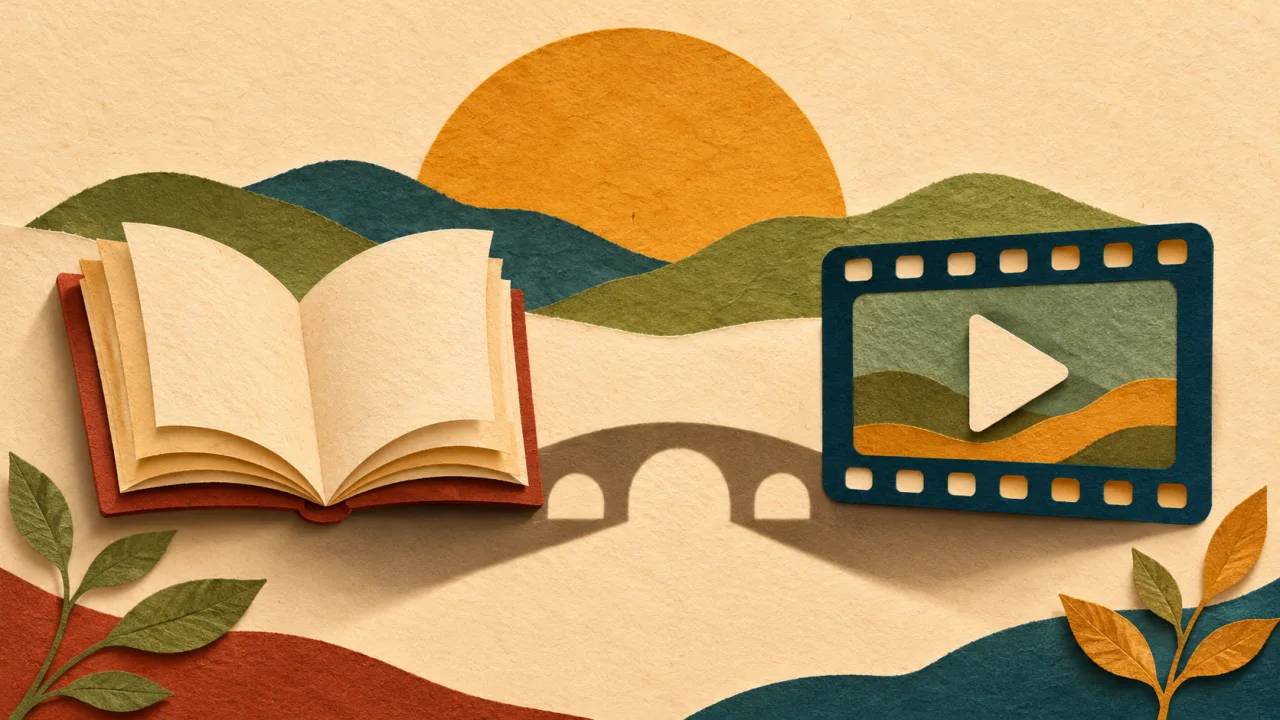
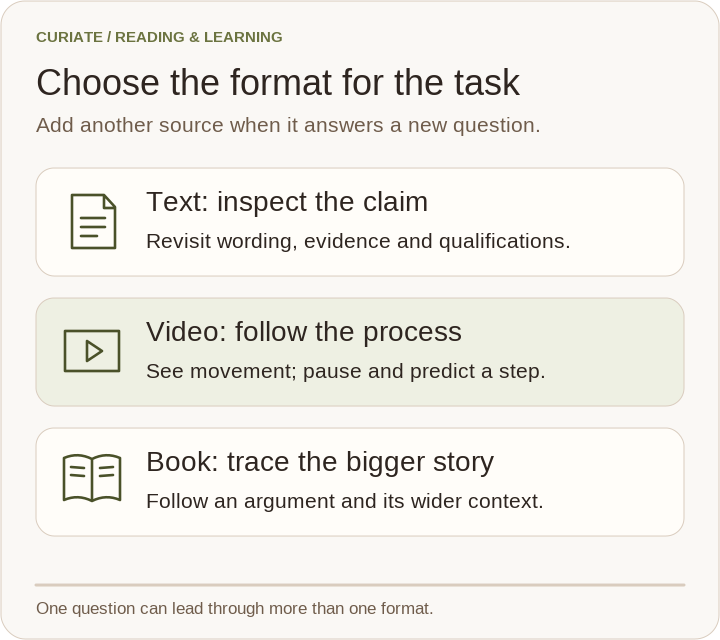
An animation makes a process look obvious. A written explanation lets you inspect the sentence you did not quite understand. A book gives an argument enough room to develop.
Which is best for learning? There is no universal winner between reading and watching videos. Choose a format that makes the information clear and usable for your task, then do something that checks your understanding. Either format can feel clear while leaving gaps you only discover when you try to explain it.
Add another format when it supplies a missing demonstration, definition, piece of evidence or longer account.
A practical starting guide
Choose according to the immediate task:
| Your immediate task | A useful starting format | What to do with it |
|---|---|---|
| Inspect a definition or compare precise claims | Text you can search and revisit | Paraphrase the claim and keep its conditions |
| Understand movement or a procedure | A clear demonstration or animation | Pause and predict the next step |
| Compare numbers or relationships | A labeled chart or diagram with explanation | Explain the axes, labels and pattern |
| Follow an argument with substantial context | A long article or book | Trace how the evidence supports the conclusion |
| Learn away from a screen | Audio, if the material and setting suit it | Pause to explain a point; return to visual details later |
Accessibility comes first. Captions, transcripts, audio description, readable text and suitable playback controls can determine whether a source is usable at all. A preference for a format is also a legitimate part of choosing what you will return to.
What the research says about video
Education researcher Michael Noetel and colleagues reviewed 105 randomized studies involving 7,776 higher-education students. Replacing existing teaching with video produced a small average learning benefit; adding video produced a larger one. The authors also noted possible experimental and publication biases. Read the review abstract.
The review compared video with varied teaching methods. Adding video can also add instruction or study time; this is not a universal reading-versus-video result.
A more direct comparison illustrates why the distinction matters. In a study led by educational psychologist Lucia Mason, university students received the same information in two complementary texts or two complementary videos. Video users spent longer processing the sources; the study also varied whether the sources came from a friend's post or a professor's course page. One study cannot show that either format is better, or that they are equivalent, in every setting, but it is a reason to doubt a sweeping claim of video superiority. Read the study.
You do not need to diagnose a learning style
You may prefer videos, or find text much easier to use. That preference is different from evidence that teaching should always be matched to a fixed “visual,” “auditory” or “reading” learning type.
Psychologist Harold Pashler and colleagues reviewed the evidence needed to test that matching claim. They found no adequate basis for incorporating learning-style assessments into general educational practice. That conclusion does not erase differences in ability, prior knowledge, access needs or personal preference. Read the review's summary.
How to learn actively from a video
Before pressing play, write the question you expect the video to answer. At a natural break, pause and explain what happened. If the video demonstrates a process, predict the next step before watching it.
Rewind the part you cannot reconstruct. Use a transcript to locate an unfamiliar term or inspect a qualification. If a demonstration is the point, look back at the demonstration rather than assuming its transcript preserves all the relevant information.
Psychologists Karl Szpunar, Novall Khan and Daniel Schacter found that inserting memory tests into online lectures reduced mind wandering and improved learning in two experiments. That supports adding opportunities to retrieve what you watched; it does not establish that every video needs the same quiz interval. Read the experiments.
A real example: learn the greenhouse effect across formats
Try this sequence of public resources, starting at the step that addresses your question.
1. Use an explanation to establish the question
Read NASA's “What is the greenhouse effect?” It explains how greenhouse gases trap heat near Earth's surface and how adding more of them raises temperatures.
Your task: write a short explanation of how greenhouse gases trap heat near Earth's surface. Check your answer against the page.
2. Use an animation to follow the process
The FAQ embeds a simplified animation credited to NASA/JPL-Caltech, also available as “The Greenhouse Effect, Simplified”. Watch it there or on its standalone page.
Your task: follow the energy pathway, including incoming sunlight and the energy Earth emits, then redraw it with labels. Compare your sketch with the explanation and note what the simplified animation leaves unanswered.
3. Use a longer account to understand how people established the science
Historian of science Spencer Weart's The Discovery of Global Warming website, hosted by the American Institute of Physics, accompanies his book of the same name. The site offers a larger, interconnected historical account; the shorter book presents the history as a continuous story.
Your next question can now be: how did scientists assemble and test their account of climate change? A sustained historical account gives competing ideas and evidence room to develop.
Three mistakes to avoid when combining formats
Repeating without a purpose. Another explanation is worthwhile if it resolves confusion, adds evidence or offers a different example. Name the gap before looking for it.
Treating different formats as independent confirmation. An article, video and book may all repeat the same source. Follow the attribution when the strength of a claim matters. Format variety does not by itself supply corroboration.
Giving yourself too much at once. Work through one coherent section, then explain it. A meta-analysis of segmenting multimedia instruction found small-to-medium gains in retention and transfer from meaningful divisions, and reported that segmenting increased learning time. Breaking a source into useful sections does not guarantee a shortcut. Read the segmenting meta-analysis.
Where Curiate's mixed-format paths fit
Curiate publishes this guide. Our app connects microlessons with original articles, videos and related books. That gives you a way to get oriented, follow a source and decide whether a subject deserves a longer read. The library is free to browse, search and save; outside publishers set access to their own material.
Quick Checks cover the in-app lessons, while Focus Quizzes draw on the sources in a path. Premium's Focus Time rewards eligible source-reading and viewing sessions by topic. In the iOS reader it counts active reading, pausing after a minute without scrolling or touching; on the web it uses the time away and return. Neither can verify comprehension.
Our microlearning app comparison covers Curiate alongside book-summary and skills-practice apps.
Frequently asked questions
Is reading better than watching videos for retention?
There is no universal answer in the research discussed here. Results depend on the material, teaching design, comparison and assessment. A useful practical approach is to choose a clear, accessible source and add an opportunity to recall or apply what it taught, then check your answer.
Can a short video replace a nonfiction book?
It may answer a specific question or introduce an idea from the book. A sustained argument, its evidence and its historical context may require much more room. Check what you want from the book before deciding whether a summary or video has met that need.