Curiate Blog
What is microlearning? Examples, benefits and limits
A short lesson earns its place by what it helps you understand or do

A short video explains a surprising fact. A card summarizes a book. A quiz asks you to apply a concept. All three can fit into a spare moment, but they ask very different things of you.
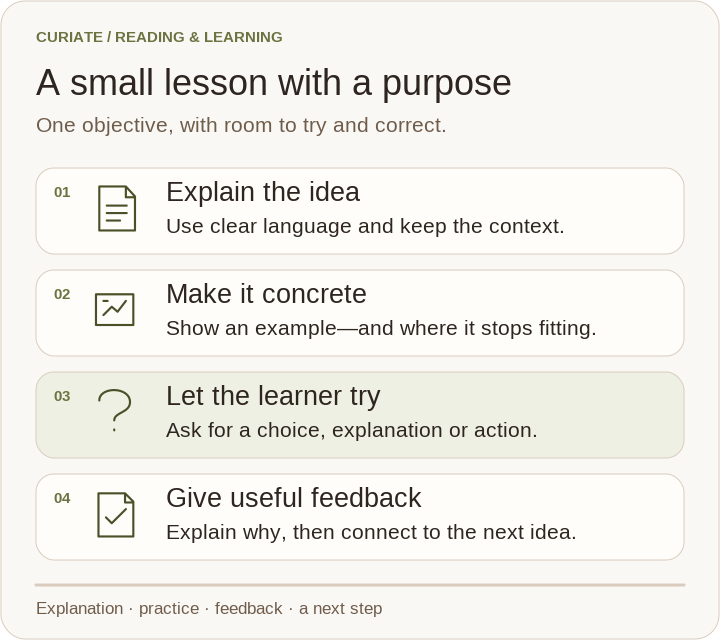
Microlearning organizes learning into small, focused units. A useful unit has a manageable objective: understand one distinction, practice one action or answer one meaningful question. It may use text, pictures, audio, video or an interactive task.
There is no universally agreed number of minutes that makes a lesson “micro.” For a learner, the more useful test is whether the unit teaches something coherent and connects to what comes next.
What counts as a microlearning example?
Here are four example designs:
| Learning goal | A possible short lesson | Evidence of progress |
|---|---|---|
| Understand a term | Explain a term, show an example and contrast a near miss | Identify which new example fits and explain why |
| Follow a process | Demonstrate one step, then let the learner perform it | Complete the step and check the result |
| Read a claim critically | Show a claim, its evidence and a missing qualification | Rewrite an overstated headline accurately |
| Retain an earlier idea | Ask a question before showing the explanation again | Recall the idea and correct the gaps |
Consider the goal “learn about science.” It is too broad for a useful short session. “Distinguish an association from a causal claim in one research headline” is narrow enough to practice while leaving room for a larger sequence on evaluating evidence.
What does the research show?
Nursing researcher Jennie De Gagne and colleagues reviewed 17 studies of microlearning in health-professions education. The authors reported positive effects on knowledge and confidence, along with drawbacks such as technology inequities and privacy concerns, and outcome measurement was uneven: most studies assessed reactions or knowledge, relatively few assessed behavior, and none evaluated benefits to patients or practice at the review's highest outcome level. The studies used varied technologies and designs. Read the scoping review.
These findings concern professional education, rather than consumer learning apps. Evidence for specific design choices is also useful: a meta-analysis by psychologist Günter Daniel Rey and colleagues examined 56 investigations of segmenting multimedia instruction. Meaningful segments produced small-to-medium benefits for retention and transfer compared with continuous presentation, especially for learners with prior knowledge, in learner-paced lessons. Learning time also increased, so this evidence does not support a simple “learn the same thing faster” promise. Segmenting coherent instruction is different from serving unrelated snippets. Read the meta-analysis.
A complete sample microlesson
This invented scenario illustrates a distinction explained in Penn State's “Relationships Between Measurement Variables” lesson.
The objective
After the lesson, distinguish “these things occurred together” from “one caused the other.”
The explanation
Imagine a survey finds that people who attend a book club report reading more books than people who do not. That association alone does not establish that attending the club caused the extra reading. People who already enjoy reading might be more likely to join. Other differences could also contribute.
The quick check
Which headline is justified by the information given?
A. Joining a book club makes everyone read more.
B. Book-club members in this survey reported reading more books.
C. Book clubs have no effect on reading.
The feedback
B fits the evidence provided. A adds a causal conclusion and a claim about everyone. C also goes beyond the evidence: failing to establish an effect is not the same as establishing no effect.
The application
Find a headline making a causal claim. Open the article and identify what kind of evidence it describes. Can you write a more precise headline without losing the interesting finding?
What a short lesson must preserve
Compression creates editorial choices. A useful lesson preserves the detail needed to interpret the central claim:
- Who or what was studied? A finding involving one group may not transfer to everyone.
- What happened? Separate a measurement from the author's interpretation.
- What is uncertain? Keep an important qualification close to the claim.
- Where did the idea come from? Give the reader a route to the original source.
Simplify vocabulary before removing meaning. “The researchers measured whether participants could keep their attention on a task” may be more accessible than an unexplained test acronym. It still tells the reader what was measured.
If the explanation cannot fit without becoming misleading, give it more room or split it at a meaningful boundary.
When microlearning is a poor fit on its own
Some tasks require sustained work: following a long historical argument, solving a substantial problem, practicing a complex procedure or comparing conflicting accounts. Small units can prepare you for those tasks and help you review afterward. They may not supply all the benefits of doing the task itself.
Periodically ask a larger question. Can you explain how three ideas connect? Apply one to a new example? Identify a disagreement between two sources? Those questions help you decide whether the sequence needs more context or practice.
How to choose a microlearning app
Before comparing streaks or lesson counts, try one session and ask:
- Can I tell what I am meant to learn?
- Does the explanation include an example and necessary qualifications?
- Do questions require understanding, or just recognizing a repeated phrase?
- Does feedback explain why an answer works?
- Can I find the source and continue beyond the short lesson?
- Is there a route through the topic, with opportunities to return to earlier material?
Our free microlearning app guide covers different kinds of learning and their free limits.
Curiate publishes this guide. We build guided paths from articles, videos and books, using microlessons to introduce ideas and link back to the original material. Quick Checks cover the in-app lessons; Focus Quizzes draw on the sources. Premium's Focus Time rewards eligible sessions spent reading or viewing those sources, rather than only moving through lesson cards. Time credit does not verify comprehension, and the research discussed here is not an evaluation of Curiate itself.
Frequently asked questions
How long is a microlearning lesson?
There is no universal cutoff. Definitions and implementations vary. A useful lesson is small enough to complete as a focused unit while preserving the context needed to understand its objective. A rigid time limit can make a difficult explanation less useful.
Is microlearning the same as a book summary?
No. A book summary condenses a larger work. A microlesson focuses on a small learning objective and can include explanation, practice and feedback. A summary may supply material for lessons, but its short length alone does not make it a complete learning activity.
Is microlearning only for workplace training?
No. Adults can use focused lessons for personal interests, language practice, general knowledge or preparation for deeper reading. Evidence from a specific workplace, school or professional setting should still be interpreted within that setting rather than treated as proof for every application.