Why leaders miss disruptive technology
Disruptive technology creates a new market or enters at the bottom of an existing one, eventually displacing established firms, products, and alliances, and Clayton Christensen and his collaborators popularized the term disruptive innovation beginning in 1995. The lessons answer why leaders miss disruptive markets and help readers understand why established firms may struggle to pursue them.
2 articles, 1 video, 1 book · about 35 min of reading and viewing
The reading path
- ReadDo you want your classroom disrupted? · Hechinger Report · 3 min read
Walmart versus the old Main Street department store and the personal computer versus the old mainframe are examples of disruptive innovation, which gradually improves until it completely dominates and puts old-school products out of business. In K-12, Christensen's original model may not fit because there are few if any non-consumers of school.
- Readdisruptive technology · Wikipedia · 26 min read
Christensen's The Innovator's Dilemma examined how hydraulic actuation slowly displaced cable-actuated machinery in the excavating and Earth-moving industry. In The Innovator's Solution, Christensen and Michael E. Raynor replaced "disruptive technology" with "disruptive innovation," recognizing that a business model, not a technology's intrinsic character, can make it a disruptive vector.
- WatchThe cult of disruptive innovation: Where America went wrong | Jill Lepore | Big Think · YouTube · 6 min watch
Jill Lepore says "'disruptive innovation' is a dangerous buzzword" and that there is "a world of difference between progress and innovation." She also argues that she can pinpoint the moment America went off the rails.
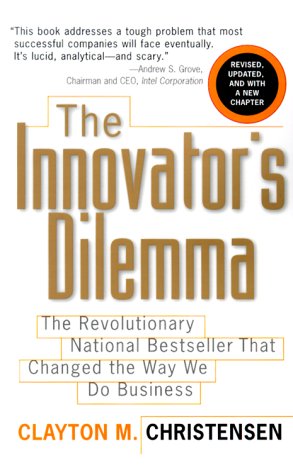
- BookThe Innovator's Dilemma · Bookshop.org
The Innovator's Dilemma by Clayton M. Christensen describes how large, outstanding firms can fail "by doing everything right" when their successes and capabilities become obstacles amid changing markets and technologies.


Book links are Bookshop.org affiliate links. Curiate may earn a commission on purchases, at no extra cost to you — Bookshop.org also gives a share to independent bookshops.
Reading paths, built to arrive somewhere
Curiate turns what you are curious about into a short path — a quick lesson on an article, something to watch, and a book to go deep on. Free to browse.