Curiate Blog
How to focus on reading when you keep getting distracted
Find the interruption, protect a small window and give your reading a clear purpose

You reach the end of a paragraph and realize you have been rehearsing a conversation. You read it again. A notification arrives. Now you are answering a message, and the article you meant to read has become another open tab.
Identify where the session breaks: before you begin, when something interrupts you, or when the explanation stops making sense.
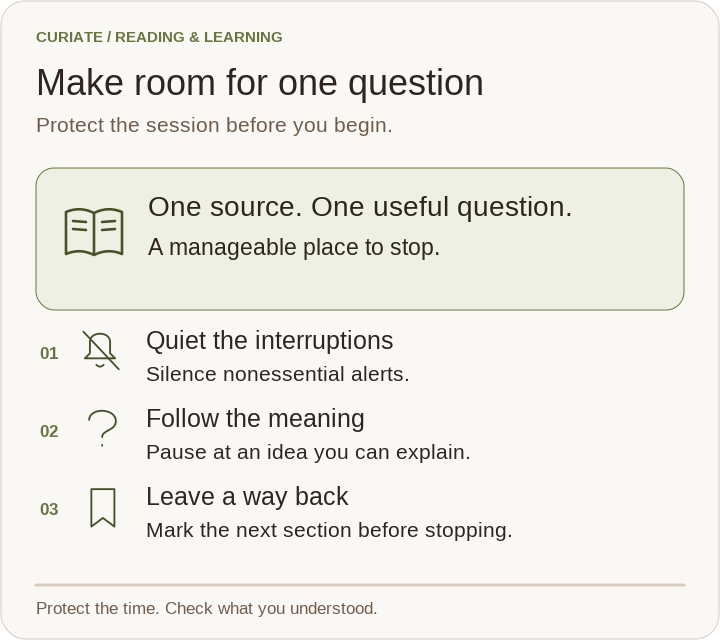
To focus on reading, choose one piece and one question, silence nonessential alerts, and read to a manageable stopping point. When your mind wanders, return to the last idea you understood and try explaining it. Start with a window you can protect, even if it is short.
First, identify the kind of distraction
These situations can feel similar but call for different changes:
| What happens | What to try first |
|---|---|
| Every alert sends you elsewhere | Silence alerts and remove the easiest route into other apps |
| You spend the whole window deciding what to read | Choose the piece before the reading window begins |
| You keep rereading an unfamiliar term | Find a clear definition or introductory explanation |
| Thoughts about unfinished work keep returning | Write down the next action and when you will return to it |
| Reading works in the morning but stalls late at night | Move the session to a time when you have more energy |
| You understand the words but cannot say what the paragraph means | Slow down and reconstruct the argument in your own words |
Why silencing notifications is worth trying
Cognitive scientist Cary Stothart and colleagues tested how phone notifications affected performance on a sustained-attention task. Participants who received calls made more errors even though they did not touch the phone; texts showed a similar but less clear effect. This was a number-response task, so its results concern sustained attention rather than reading comprehension. Read the researcher's account and study links.
A larger intervention examined constant connectivity. In a 2025 randomized study, 467 iPhone users were enrolled to block mobile internet for two weeks, either immediately or after a waiting period; 313 completed all the surveys. Calls and texts remained available, as did internet access on other devices. The researchers reported a small improvement in objectively measured sustained attention, among other outcomes, in a motivated, iPhone-only sample. Following the intervention was difficult: only 119 participants met the compliance threshold of at least ten of the fourteen days. Read the study.
Blocking internet for two weeks is a different intervention from silencing alerts for a session. The finding supports examining constant connectivity, without establishing a particular reading routine.
Try one protected reading session
Before: choose the piece and the finish line
Open one article, chapter or section. Decide what you want to understand and where you will stop.
For example: “I want to understand why the author thinks this policy failed. I will read through the section explaining the evidence.” That gives you something more useful than a page-count target when the material is unfamiliar.
If a timer helps, try ten minutes and adjust to your day. This is a starting suggestion, not a proven training dose.
Then prepare the device:
- Turn on a focus mode, allowing through genuinely necessary contacts.
- Close unrelated tabs or put the article in a clean reading view.
- If you are reading on paper or a separate device, move your phone somewhere less convenient to reach.
- If you are reading on your phone, keep that one source open and make switching to feeds less convenient.
During: leave yourself a route back
When a distracting thought arrives, jot a few words on a separate list: “reply to Sam after lunch.” Then return to the text. Keep it brief.
When you notice you have drifted, find the last sentence or idea you understood. Ask: “What is the author trying to establish here?” Read forward from there.
If the same passage keeps defeating you, change the task. Look up one prerequisite, sketch the relationship between two ideas, or read an introductory source. Repeating unfamiliar words at greater speed is unlikely to supply their missing meaning.
For a long explanation, pause at a natural boundary and say what you have learned so far. In two experiments with online lectures, psychologists Karl Szpunar, Novall Khan and Daniel Schacter found that inserting memory tests reduced mind wandering and improved learning. Those experiments used memory tests on video lectures, so saying what you have learned is an analogy rather than the same intervention. Read the experiments.
After: check what helped
At your stopping point, answer three quick questions:
- What did I understand that I did not understand before?
- What interrupted me?
- What should I change next time?
“Nine minutes, two message interruptions, understood the main claim” tells you more than “bad focus.” Next time, you can change the message setting and compare the experience.
Use progress tracking without confusing it with understanding
Curiate publishes this guide. Our app offers a finite discovery feed and guided paths through articles, videos and books, with short lessons to help you decide where to explore further.
Premium's Focus Time gives source-reading and viewing sessions visible credit by topic, with a daily goal and a streak for days you meet it. In the iOS app's built-in reader, credit counts active reading and pauses after a minute without scrolling or touching. On the web, where articles open on the publisher's site, credit uses the time between leaving Curiate and returning. Sessions under a minute do not qualify. Neither method can verify that you attended to or understood the article throughout that time.
Pair a timer with a short explanation of what you read: one records time, the other helps you check understanding. Read why we built Focus Time, or explore alternatives to doomscrolling for a different starting activity.
Frequently asked questions
How long should I read to improve concentration?
There is no single duration established by the studies discussed here. Start with a window you can protect and a meaningful stopping point. Ten minutes is a practical experiment, not a treatment or a guaranteed training dose. Extend the window when it remains useful.
Is reading on a phone always worse for focus?
The phone also provides routes into messages, alerts and other apps, which can make a reading session harder to protect. Try focus mode and a single open source before deciding you need another device. The notification research discussed here does not establish that everyone learns better from paper.