Technology in business, data storage, and outcomes
Technology in business uses computers, telecommunications systems, and other devices to create, process, store, retrieve, and transmit information. How can technology support business value? You'll understand how data systems and storage serve organizational needs, and how teams can connect their work and measures to business outcomes.
2 articles, 1 book
The reading path
- Readtechnology in business · Wikipedia
Development teams track speed and quality, while business leaders measure revenue growth, customer retention, and profit margins. Broadcom's Serge Lucio said faster software delivery does not necessarily mean delivering software that meets business needs; he said BizOps puts business outcomes at the center, helping bridge the gap between the groups and their metrics.
- Read"Manifesto Hatched to Close Gap Between Business and IT" · technewsworld.com
Database management systems emerged in the 1960s to address the problem of storing and retrieving large amounts of data accurately and quickly, helping organizations manage data for business needs. Their components allow many users to access stored data simultaneously while maintaining its integrity, and a database schema defines the data's structure separately from the data itself. By 2007, almost 94% of the data stored worldwide was held digitally, and worldwide electronic storage capacity was estimated to have grown from less than 3 exabytes in 1986 to 295 exabytes in 2007, doubling roughly every 3 years. This growth shows how storage technology expanded the capacity businesses could draw on.
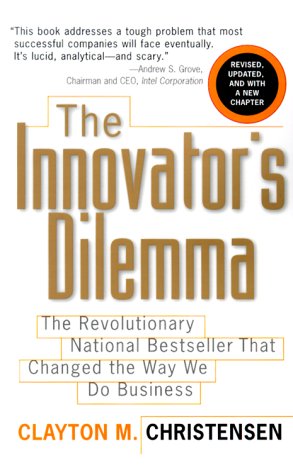
- BookThe Innovator's Dilemma · Bookshop.org
The Innovator's Dilemma by Clayton M. Christensen describes how large, outstanding firms can fail "by doing everything right" when their successes and capabilities become obstacles as markets and technologies change.


Book links are Bookshop.org affiliate links. Curiate may earn a commission on purchases, at no extra cost to you — Bookshop.org also gives a share to independent bookshops.
Reading paths, built to arrive somewhere
Curiate turns what you are curious about into a short path — a quick lesson on an article, something to watch, and a book to go deep on. Free to browse.