History of mathematics and changing ways of thought
The history of mathematics deals with the origin of discoveries in mathematics and the mathematical methods and notation of the past. How have mathematical ideas met practical needs and changed how people represent and imagine the world? By the end, readers will understand how mathematical tools and concepts can shape both everyday systems and broader ideas about reality and the mind.
2 articles, 1 book
The reading path
- Readthe history of mathematics · Wikipedia
Babylonian mathematics used a base-60 place-value notation that could represent fractions as easily as whole numbers, making fractional multiplication much like multiplying integers. Its computational power is vivid in tablet YBC 7289, which gives an approximation of √2 accurate to five decimal places, though the Babylonians lacked a decimal point and place value often had to be inferred from context. Brahmagupta, a 7th-century mathematician, explained zero as both a placeholder and decimal digit and described the Hindu-Arabic numeral system. A translation of this Indian text on mathematics (c. 770) introduced the system to Islamic mathematicians, who adapted it as Arabic numerals; Islamic scholars carried it to Europe by the 12th century, and it has displaced older number systems throughout the world.
- BookFlatland: A Romance of Many Dimensions · Bookshop.org
In 1904, mathematician C. H. Hinton presented the fourth dimension as a physically existing space that people might learn to see, linking higher mathematics to a hoped-for "New Era of Thought." His coloured cubes could be mentally assembled to visualise a four-dimensional object he called a "tesseract"; Hinton also promised that mastering the visualisation would open new horizons and develop the mind's power. He saw the dimension as psychically real, able to explain ghosts and ESP.
- ReadNotes on the Fourth Dimension · The Public Domain Review
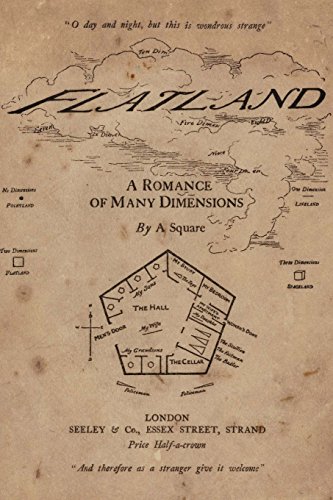
Flatland by Edwin A. Abbott is a work of science (and mathematical) fiction that offers a satirical, imaginative way to engage with mathematics.


Book links are Bookshop.org affiliate links. Curiate may earn a commission on purchases, at no extra cost to you — Bookshop.org also gives a share to independent bookshops.
Reading paths, built to arrive somewhere
Curiate turns what you are curious about into a short path — a quick lesson on an article, something to watch, and a book to go deep on. Free to browse.