Quantum mechanics and its challenges to classical physics
Quantum mechanics can describe many systems that classical physics cannot. How do quantum rules challenge classical expectations about waves, distant systems, and atoms? By the end, readers will understand how quantum behavior differs from classical explanations and where classical assumptions fall short.
2 articles, 1 book
The reading path
- Readquantum mechanics · Wikipedia
In the double-slit experiment, light waves passing through two slits produce bright and dark bands, but light is absorbed at the screen in discrete points. This wave-particle duality shows how quantum mechanics defies classical expectations. Bell inequalities is the name for constraints on correlations between distant systems implied by locality and determinism. In 1964, physicist John Bell showed that these principles conflict with quantum mechanics, and experiments found correlations that violate the constraints, falsifying their conjunction.
- ReadThe (Often) Overlooked Experiment That Revealed the Quantum World | Quanta Magazine · Quanta Magazine
Stern and Gerlach sent vaporized silver atoms through a nonuniform magnetic field. Niels Bohr, a physicist who proposed a theory of the atom, said tiny systems like atoms obeyed quantum rules, meaning the silver atoms could take only two paths through the field; the detector showed two deposits. The scientists assumed the split came from the orbit of the outermost electron, but it was actually due to the electron's internal angular momentum, called spin.
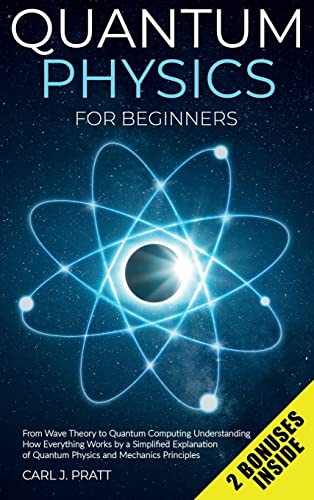
- BookQuantum Physics for Beginners: A Simple Guide to Quantum Mechanics · Bookshop.org
Quantum Physics for Beginners by Carl J. Pratt provides an accessible introduction to the fundamental concepts of quantum mechanics, helping readers grasp the counterintuitive nature of the quantum world without overwhelming technical jargon.


Book links are Bookshop.org affiliate links. Curiate may earn a commission on purchases, at no extra cost to you — Bookshop.org also gives a share to independent bookshops.
Reading paths, built to arrive somewhere
Curiate turns what you are curious about into a short path — a quick lesson on an article, something to watch, and a book to go deep on. Free to browse.