Tech entrepreneurship from opportunity to viable business
Tech entrepreneurship is the creation or extraction of economic value through identifying and commercializing opportunities to deliver products or services. How do entrepreneurs determine whether an opportunity can become a viable business? By the end, readers will understand how venture ideas develop through action, resources and financing shape their prospects, growth ambitions distinguish entrepreneurial ventures, and low-cost experiments test demand.
2 articles, 1 book
The reading path
- Readtech entrepreneurship · Wikipedia
Before a venture is established, an opportunity is only a venture idea, supported by the nascent entrepreneur's personal beliefs about whether the desired outcomes are feasible. Its value becomes clear only gradually through actions toward establishing the venture, which may lead to a viable business or a decision to stop. Nascent entrepreneurs often make the idea concrete by seeking financial backing, forming legal entities, and organizing teams. Tangible resources such as equipment, cash and inventory can be quantified, while intangible resources-including skills, reputation, networks and intellectual property-can have more value-creating capacity. Yet access to finance remains an important constraint: the Global Entrepreneurship Monitor's 2025/2026 Global Report found that funding difficulties remain a significant barrier to starting and developing businesses across many economies. Many small businesses offer an existing product, process or service and do not aim at growth, while entrepreneurial ventures offer an innovative product, process or service and the entrepreneur typically aims to scale up the company by adding employees or seeking international sales, a process financed by venture capital and angel investments. The term "entrepreneur" is often conflated with "small business", while "entrepreneur" may be more closely associated with "startup".
- BookThe Lean Startup · Bookshop.org
A clearly hypothetical two-person team offers a simple order form and shared spreadsheet free to three independent bakeries for two weeks, rather than building an app, to test whether owners will pay for online pre-orders. If owners shrug, the team learns cheaply; if they ask what it will cost, the next experiment is a price test.
- Read"The Lean Startup Method Explained: Build, Measure, Learn" · resources.rework.com
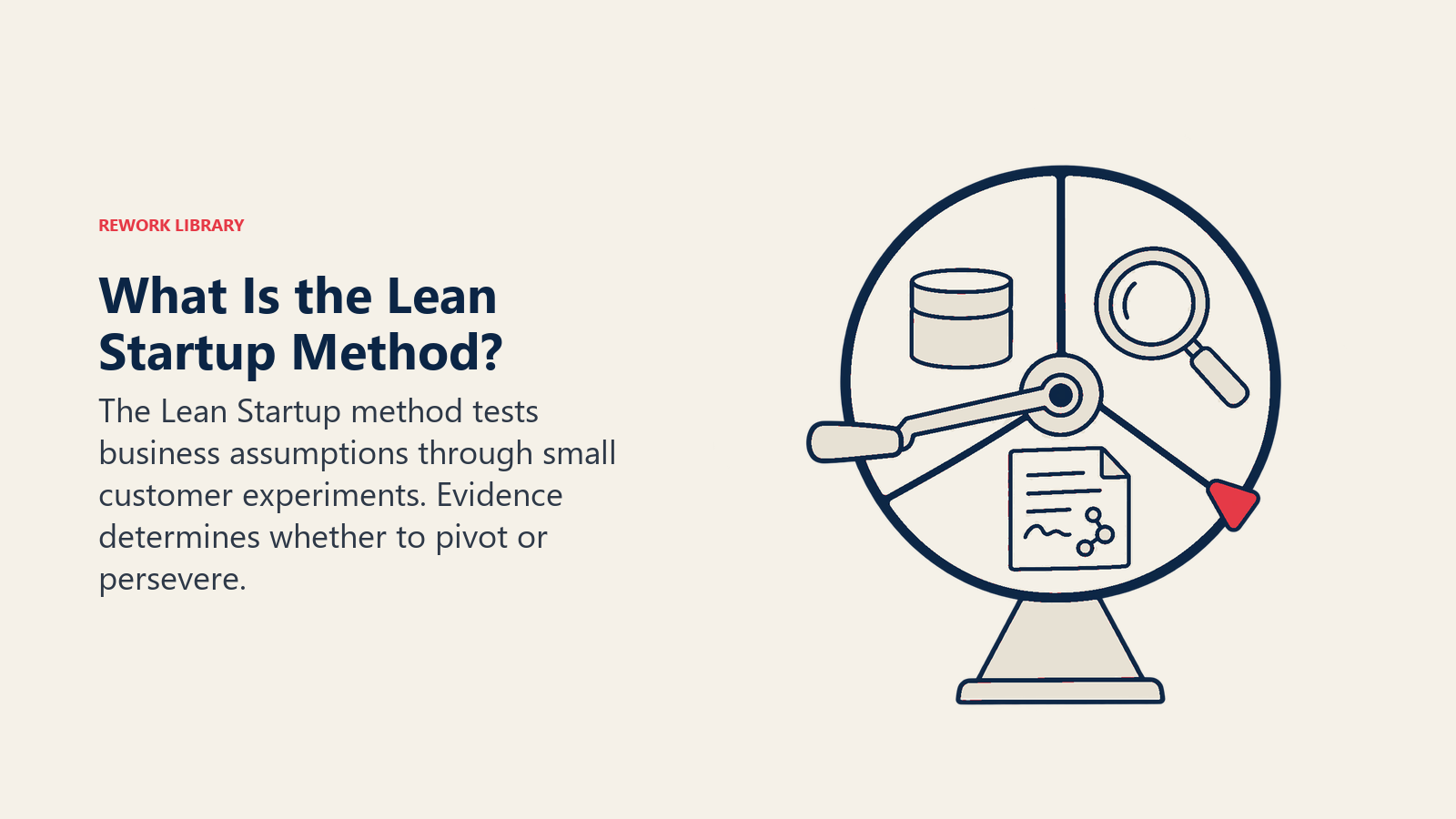
The Lean Startup by Eric Ries defines a startup as an organization creating something new under extreme uncertainty and describes validated learning and rapid scientific experimentation to measure progress, learn what customers want, and test a vision continuously so entrepreneurs can adapt before it's too late.
Book links are Bookshop.org affiliate links. Curiate may earn a commission on purchases, at no extra cost to you — Bookshop.org also gives a share to independent bookshops.
Reading paths, built to arrive somewhere
Curiate turns what you are curious about into a short path — a quick lesson on an article, something to watch, and a book to go deep on. Free to browse.