Thermodynamics, entropy, and time's direction
Thermodynamics is a branch of physics dealing with heat, work, temperature, and their relation to energy, entropy, and the physical properties of matter and radiation. How do microscopic behavior and entropy help explain the direction of change in physical systems and the universe? By the end, readers will understand how thermodynamics connects microscopic and large-scale behavior, irreversible change, and cosmic evolution.
3 articles, 1 book
The reading path
- Readthermodynamics · Wikipedia
Statistical mechanics relates the microscopic properties of individual atoms and molecules to the bulk properties of materials observable on the human scale, explaining classical thermodynamics as a natural result of statistics, classical mechanics, and quantum theory at the microscopic level. It interprets the microscopic interactions of individual particles or quantum-mechanical states. Entropy is a thermodynamic quantity that increases as constraints are removed in an isolated system approaching equilibrium. As a system's temperature approaches absolute zero, all processes cease and its entropy approaches a minimum value; the third law also says absolute zero cannot be reached and provides an absolute reference point for determining entropy.
- ReadSecond Law - Entropy | Glenn Research Center | NASA · Glenn Research Center | NASA
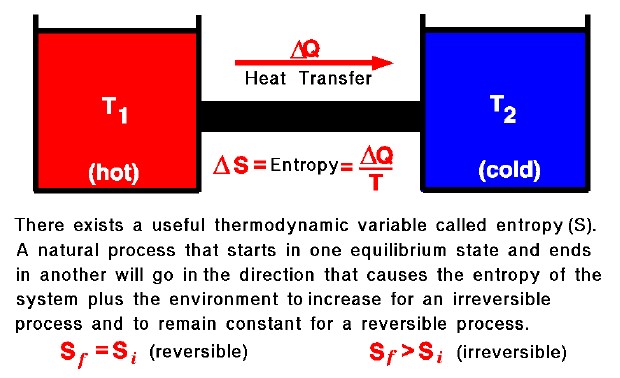
Entropy is a property of a system, with interpretations including statistical disorder. When a hot object touches a cold one, heat flows from hot to cold until they reach the same temperature; they do not naturally return to their original different temperatures. The second law says entropy must increase in an irreversible process, explaining why heat flows in that direction rather than from cold to hot.
- ReadCould quantum information theory explain universe evolution? · Physics World
Radiation-dominated universe is a universe whose expansion is driven by radiation. In radiation- and matter-dominated universes, expansion outpaces the decay of entropy density, so total entropy increases even as local entropy per unit volume decreases, allowing low-entropy structures such as galaxies to form and preserving the second law of thermodynamics.
- BookThe Order of Time · Bookshop.org
The Order of Time (Italian: L'ordine del tempo) is a book by Italian physicist Carlo Rovelli, a specialist in quantum gravity research, about time in physics. An audiobook, four hours and nineteen minutes long, was read by Benedict Cumberbatch.



Book links are Bookshop.org affiliate links. Curiate may earn a commission on purchases, at no extra cost to you — Bookshop.org also gives a share to independent bookshops.
Reading paths, built to arrive somewhere
Curiate turns what you are curious about into a short path — a quick lesson on an article, something to watch, and a book to go deep on. Free to browse.