Analysis in analytic philosophy
Analytic philosophy is a broad style of contemporary Western philosophy that uses clear language, careful reasoning, logic, mathematics, and science, and pays close attention to language and meaning. These lessons answer how analysis shapes philosophical debate and help readers understand its role in philosophical method. They trace how different approaches to analysis inform philosophical arguments.
2 articles, 1 book · about 2 hr 11 min of reading and viewing
The reading path
- Readanalytic philosophy · Wikipedia · 60+ min read
Gottlob Frege, a German geometry professor at the University of Jena, logician, and philosopher, is understood as the father of analytic philosophy. He advocated logicism, the project of reducing arithmetic to pure logic, supporting Leibniz and opposing Kant in the philosophy of mathematics. In analytic philosophy, the later Wittgenstein introduces the concept of a "language-game" as a "form of life"; he argued that a word or sentence has meaning only as a result of the "rule" of the "game" being played.
- ReadAnalysis (Stanford Encyclopedia of Philosophy) · plato.stanford.edu · 46 min read
Analysis has always been at the heart of philosophical method, but it has been understood and practiced in many different ways. In its broadest sense, it might be defined as identifying or working back to what is more fundamental, by means of which something initially taken as given can be derived, explained or reconstructed.
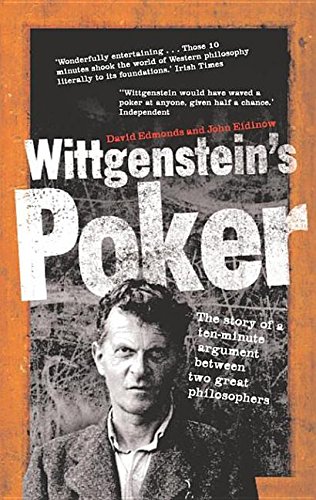
- BookWittgenstein's Poker · Bookshop.org
Wittgenstein's Poker by David Edmonds and John Eidinow recounts Popper's presentation and the heated argument over whether philosophy has substantial problems or merely linguistic puzzles. Popper later claimed that Wittgenstein challenged him to give an example of a moral rule, and that he replied, "Not to threaten visiting lecturers with pokers."
Book links are Bookshop.org affiliate links. Curiate may earn a commission on purchases, at no extra cost to you — Bookshop.org also gives a share to independent bookshops.
Reading paths, built to arrive somewhere
Curiate turns what you are curious about into a short path — a quick lesson on an article, something to watch, and a book to go deep on. Free to browse.