How habitat fragmentation isolates populations
Habitat fragmentation is the emergence of discontinuities in an organism's preferred environment, causing population fragmentation and ecosystem decay; more specifically, it divides large, contiguous habitats into smaller, isolated patches. How do isolation and connections between patches affect populations? You'll understand how habitat loss and barriers shape movement, population persistence, and the potential for wildlife corridors to connect habitats.
2 articles, 1 book
The reading path
- Readhabitat fragmentation · Wikipedia
Habitat fragmentation often involves both habitat destruction and the subdivision of previously continuous habitat, and habitat subdivision or isolation can lead to changes in species' dispersal or movement. Small, isolated populations can be devastated by minor fluctuations that larger populations quickly recover from. In continuous habitat, immigration from a nearby expanding population can rescue a declining one, but distances between fragments may block rescue and barriers can leave empty fragments less likely to be repopulated. Wildlife corridors may mitigate isolation by linking habitat fragments, though they do not address the loss of interior habitat. Corridors can help animals move when resources are lacking in their core habitat and find mates in neighbouring regions, so genetic diversity can increase.
- ReadHabitat Fragmentation Prevents Migration During Climate Change - Eos · Eos
Only 2% of the eastern United States contains connected green space for animals to find new homes, and the East Coast's habitat is already in very small patches, says study author Jenny McGuire, a research scientist at Georgia Tech in Atlanta. Only 2% of the eastern plains and coastal areas have cool sites adjacent to warm zones, though eastern species able to traverse 10-kilometer corridors can access 16% climate connectivity.
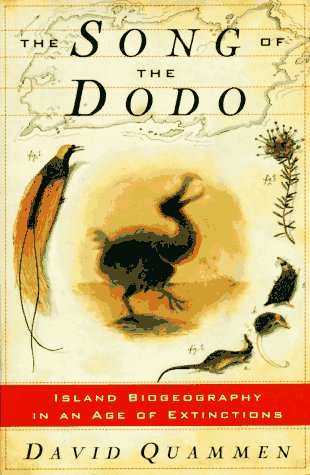
- BookThe Song of the Dodo: Island Biogeography in an Age of Extinctions
The Song of the Dodo by David Quammen traces naturalists' ideas, theories, and experiments alongside his travels tracking island biogeography, and Quammen points out that human activity chops Earth's landscapes into island-like fragments, connecting habitat fragmentation to the study of species' origins and extinctions.


Book links are Bookshop.org affiliate links. Curiate may earn a commission on purchases, at no extra cost to you — Bookshop.org also gives a share to independent bookshops.
Reading paths, built to arrive somewhere
Curiate turns what you are curious about into a short path — a quick lesson on an article, something to watch, and a book to go deep on. Free to browse.