How saving comes before investing in personal finance
Personal finance is how an individual or family manages money to budget, save, and spend in a controlled way, while considering risks and future needs. What does it take to plan for financial goals, and why does saving come before investing? The lessons connect everyday money management with planning for future needs and building financial security.
2 articles, 1 video, 1 book · about 27 min of reading and viewing
The reading path
- Readpersonal finance · Wikipedia · 20 min read
Personal finance planning involves five steps, beginning with an assessment of a person's financial situation by compiling simplified financial statements. A personal balance sheet lists personal assets, such as a car or bank account, alongside liabilities such as credit card debt or a mortgage. Investment and accumulation goals are what most people consider financial planning: planning how to accumulate enough money for large purchases and life events. Achieving these goals requires projecting their costs and when to withdraw funds. Average life expectancy has increased even in developing economies, and it has gradually risen from 60 to 81 years and above. Coupled with a shorter employable age, this reinforces the need for a sufficiently large retirement corpus and the importance of personal finance.
- ReadSaving is For the Poor, Investing is For the Rich · Of Dollars And Data · 4 min read
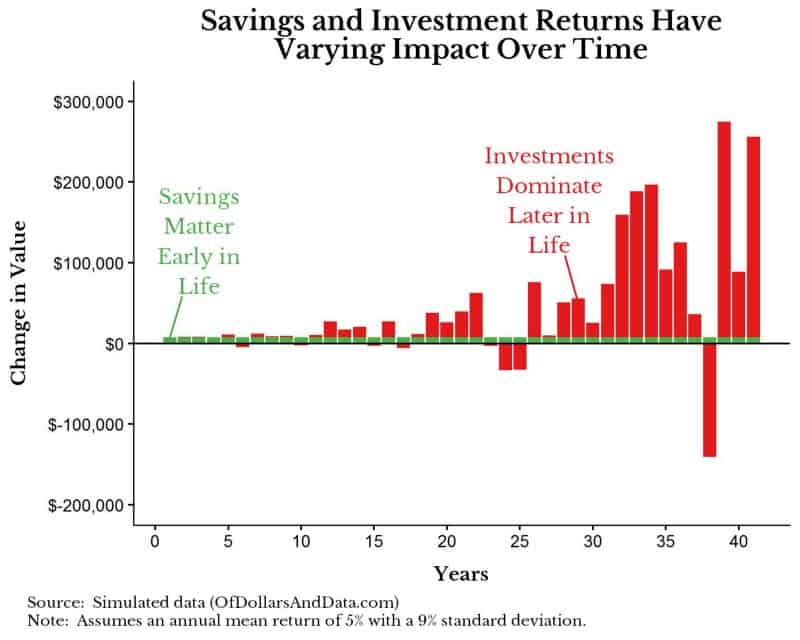
In a 40-year simulation, someone saving $7,500 annually would save $300,000, while investments would gain about $1.6 million, 84% of the total assets in year 40. The guidance is to focus on saving when annual savings exceed what existing assets are expected to earn, and on investments when those earnings are greater.
- WatchBudgeting and the 50:30:20 rule | Financial mathematics (TX TEKS) | Khan Academy · YouTube · 3 min watch
Saving has its own share under the 50-30-20 guideline: 20% of income goes to savings, and the rest goes to necessities and discretionary spending.
- BookThe Millionaire Next Door · Bookshop.org
The Millionaire Next Door, by Thomas J. Stanley, follows profiles of American millionaires; in "UAWs versus PAWs," Stanley and coauthor William D. Danko describe under-accumulators as focusing on consuming income rather than saving. Their section on "Family and Generational Wealth" adds that their parents are less likely to have taught them about money, budgeting, or investing.


Book links are Bookshop.org affiliate links. Curiate may earn a commission on purchases, at no extra cost to you — Bookshop.org also gives a share to independent bookshops.
Reading paths, built to arrive somewhere
Curiate turns what you are curious about into a short path — a quick lesson on an article, something to watch, and a book to go deep on. Free to browse.