Why quantum mechanics defies classical physics
Quantum mechanics, also known as quantum physics, describes how matter and light behave, typically at and below the scale of atoms, and its behaviors have often been described as counterintuitive. This path helps readers understand the theory in everyday terms and explores how it describes the behavior of matter and light.
2 articles, 1 video, 1 book · about 1 hr 5 min of reading and viewing
The reading path
- Readquantum mechanics · Wikipedia · 44 min read
Quantum interference, a consequence of quantum mechanics, is often illustrated by the double-slit experiment: coherent light passing through two slits produces bright and dark bands on a screen, a result not expected if light consisted of classical particles. A particle in a one-dimensional potential energy box shows how restraints lead to quantized energy levels. The box has zero potential energy inside a region and infinite potential energy outside it. In quantum mechanics, an electron in an unexcited atom is described by a static wave function surrounding the nucleus, rather than as a particle moving in a circular trajectory around it. In an unexcited hydrogen atom, this wave function is a spherically symmetric s orbital.
- ReadThe (Often) Overlooked Experiment That Revealed the Quantum World | Quanta Magazine · Quanta Magazine · 7 min read
In 1922, Gerlach and colleagues ran the Stern-Gerlach experiment: after shooting silver at the detector, they found a silver deposit neatly split in two. Gerlach sent Bohr a microphotograph of the result with the message, "We congratulate you on the confirmation of your theory."
- WatchSuperposition of Quantum States · YouTube · 14 min watch
Quantum superposition and the Stern-Gerlach experiment are at the heart of why quantum mechanics defies classical physics.
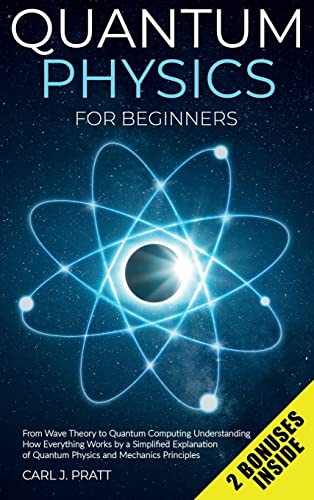
- BookQuantum Physics for Beginners: A Simple Guide to Quantum Mechanics · Bookshop.org
Quantum Physics for Beginners provides an accessible introduction to the fundamental concepts of quantum mechanics, with little technical jargon.


Book links are Bookshop.org affiliate links. Curiate may earn a commission on purchases, at no extra cost to you — Bookshop.org also gives a share to independent bookshops.
Reading paths, built to arrive somewhere
Curiate turns what you are curious about into a short path — a quick lesson on an article, something to watch, and a book to go deep on. Free to browse.